
Subscribe to our newsletter
One short email when we publish. No spam, unsubscribe anytime.
Deploy Your Own AI Agent with Live X Data Using Grok and OpenClaw
xAI Brings Grok to OpenClaw: A New Chapter for Local-First AI Agents
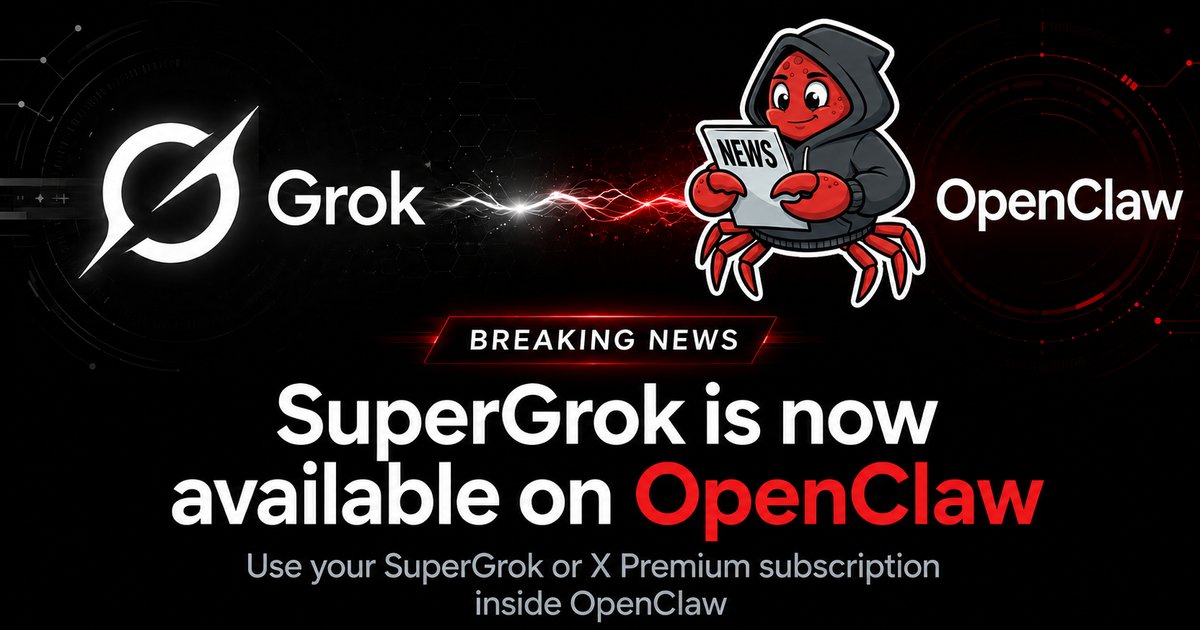
xAI has officially brought Grok into OpenClaw, the open-source, local-first AI agent platform, in a move that quietly reshapes how everyday users and developers can put a powerful model to work. Announced in mid-May 2026 and rolling out to subscribers within days, the integration lets people connect Grok to their own self-hosted agent without wrestling with API keys or cloud lock-in. For an industry still dominated by closed, browser-based assistants, it is a notable bet on a different model of ownership.
What Was Announced
The headline change is simple but significant. SuperGrok subscribers (30 dollars per month) and X Premium subscribers (8 dollars per month) can now sign in to Grok inside OpenClaw using a standard OAuth flow. There is no need to manually configure an XAI_API_KEY environment variable or set up separate billing for standard chat. OpenClaw shipped native OAuth login for xAI in its v2026.5.16 beta releases on May 16, and the capability has since matured through the platform's rapid release cycle.
Under the hood, OpenClaw talks to Grok through an OpenAI-compatible API layer pointed at api.x.ai/v1. Grok 4.3 is the default chat model, bringing advanced reasoning, a one million token context window, and strict instruction adherence. Power users can switch to other options, including Grok 4.1 Fast with a two million token context that is well suited to summarizing thousands of pages or scanning large code bases.
The Real Differentiator: Live X Search
The feature that sets this integration apart is real-time access to X (formerly Twitter). Grok is the only major model with native, live access to X data, and that advantage now flows directly into a local agent. With the Responses API enabled, an OpenClaw agent can semantically search X posts, filter by keyword, look up posts from specific users, fetch entire threads, and blend that social signal with web search and local file operations inside a single reasoning loop.
In practice, this means an agent can answer questions that static, training-cutoff models simply cannot. It can track breaking discussions, gauge sentiment around a brand or topic, monitor a competitor's announcements, and combine those findings with documents stored on the user's own machine. Alongside chat and X search, the integration also unlocks image and video generation and secure code execution.
Why Local-First Matters
OpenClaw is built around a different philosophy than the typical cloud assistant. It runs on hardware the user controls, from a Mac Mini or laptop to a small VPS or even a Raspberry Pi. It keeps persistent memory across sessions, so the agent remembers past conversations, decisions, and learnings, and it can search that memory by meaning rather than keywords. Crucially, it can take real actions on the user's behalf: reading files, sending messages, browsing the web, running scripts, and managing workflows across messaging apps like WhatsApp, Telegram, Slack, and Discord.
The Grok integration follows a hybrid pattern. Light work and personal data stay local, while heavy reasoning and live data retrieval are handed off to xAI's cloud before results return to the user's machine for storage and action. This keeps sensitive context close to home while still tapping premium internet-scale intelligence, a balance that directly addresses growing concerns about data privacy and vendor dependence.
The Strategic Picture
For xAI, the integration is a distribution play. Rather than competing only through its own app, it embeds Grok into an open ecosystem where developers already build, extend, and self-host. That broadens Grok's reach across workflows and messaging channels that proprietary assistants do not cover.
There is an economic story too. As open-source orchestration layers mature and inference costs fall, the value of paying for a closed wrapper diminishes. By letting existing SuperGrok and X Premium subscribers reuse their subscriptions inside OpenClaw, xAI lowers the barrier to entry and makes local agent deployments genuinely viable for individuals and small teams. One caveat remains: while standard chat is covered by the subscription, heavy tool use can still accumulate separate costs, so production workloads deserve monitoring.
What to Watch
The combination of a capable model, live social data, persistent memory, and real action across everyday channels is a meaningful step toward agents that feel less like chatbots and more like assistants that actually do things. Expect competitors to respond, and expect the OpenClaw community to keep extending the integration through community plugins. For anyone weighing a private, controllable alternative to cloud assistants, this is one of the more practical milestones of 2026 so far.
Helpful documentation
Want your own AI agent running without the setup? We host it on a dedicated EU server. Free for 7 days, no credit card.
Start your free trialGet notified when we publish new articles
No spam, unsubscribe anytime.
By subscribing, you agree to our Privacy Policy.