
Subscribe to our newsletter
One short email when we publish. No spam, unsubscribe anytime.
The OpenClaw founder on what ships next
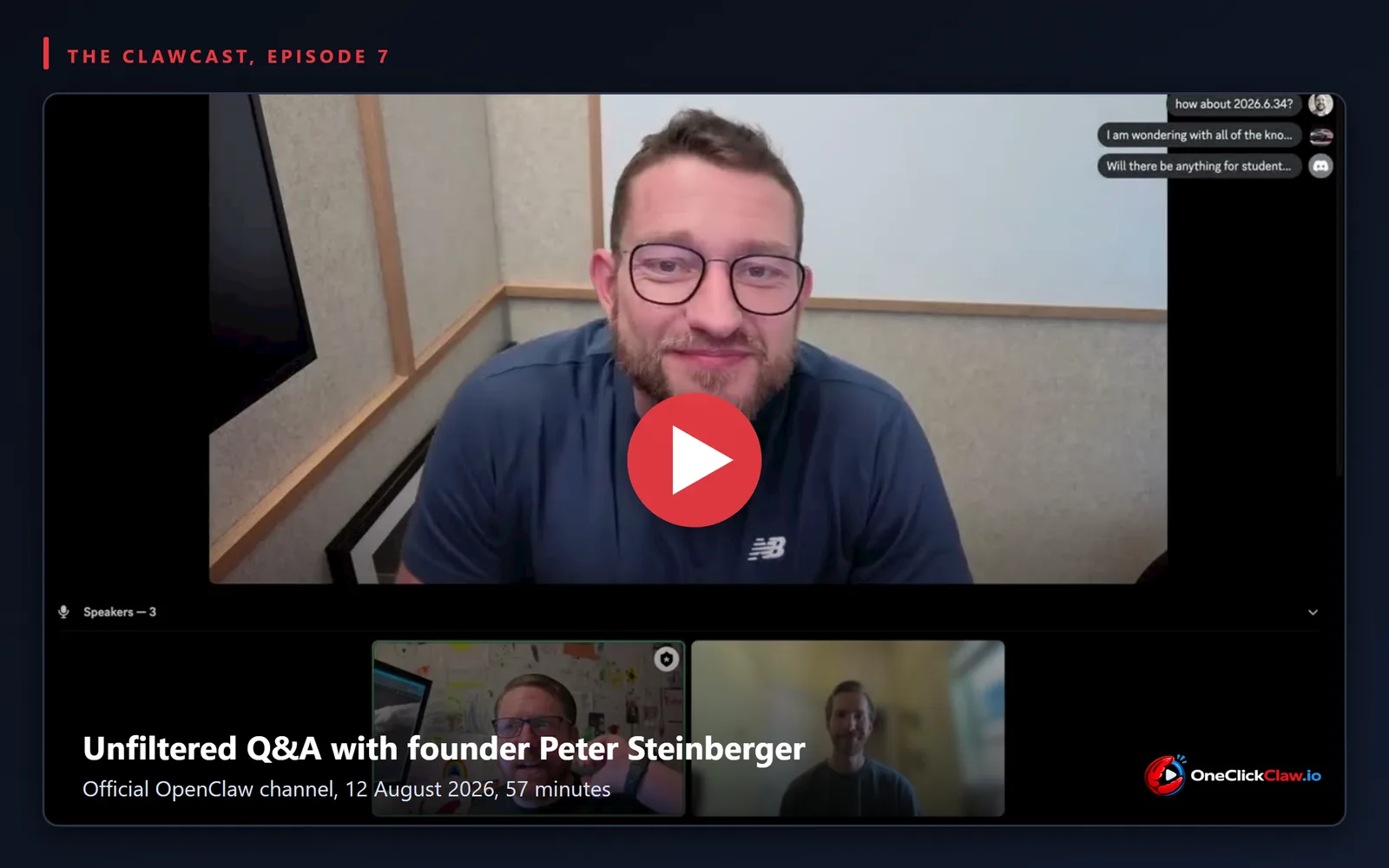
The founder of OpenClaw sat down for an hour of unscripted questions and spent most of it describing the next version. Not a roadmap slide. The actual thing, running on his machine, days from release.
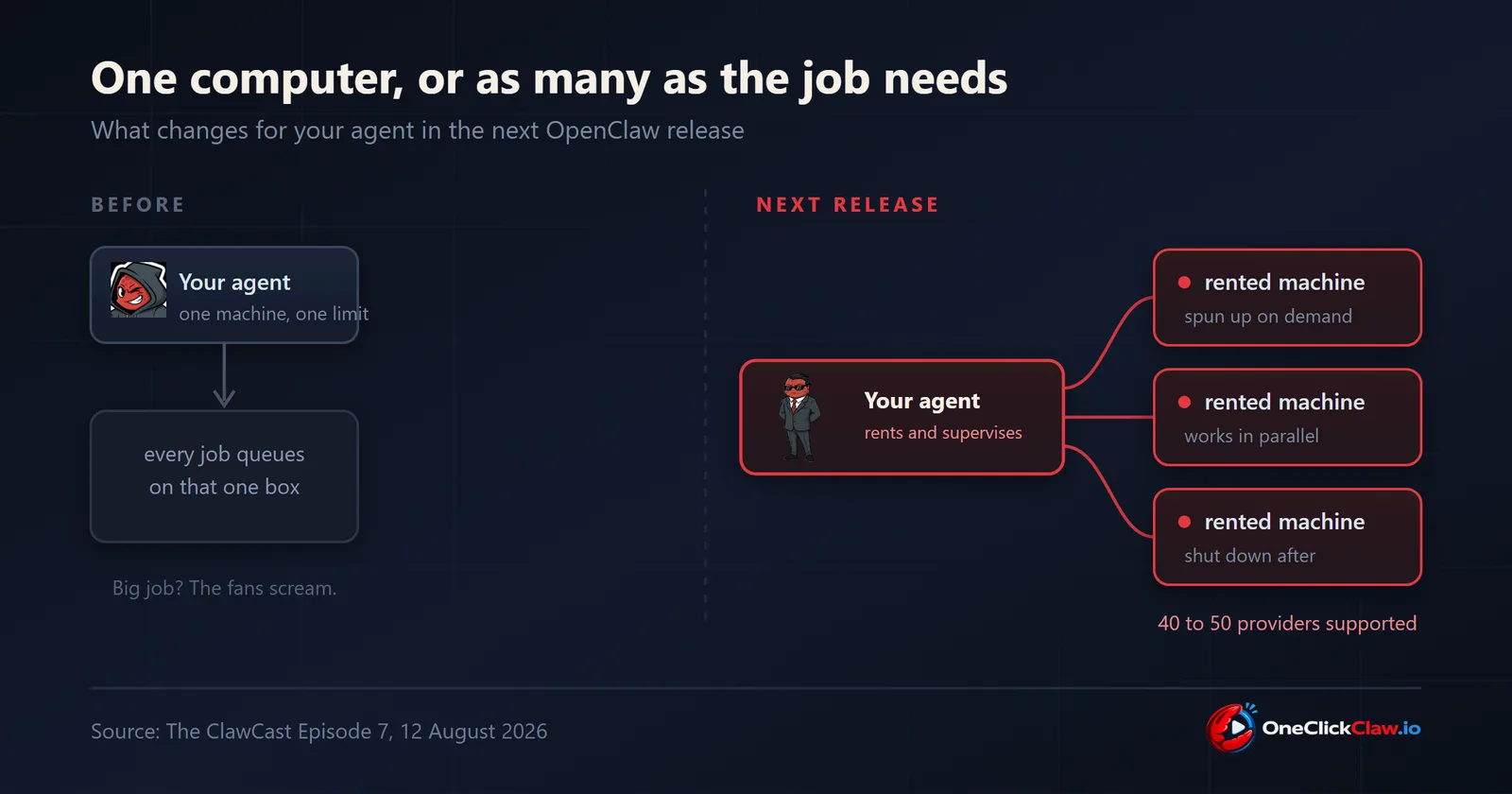
Your agent stops living on one computer
Until now your agent worked wherever you installed it. One machine, one set of limits. Steinberger described what that felt like at scale: fans screaming like a jet engine, then a second computer, then a third, then him sitting in the middle deciding which machine was least busy.
In the next release the agent handles that itself. It spins up remote sessions in the cloud, puts them to work, supervises them, and shuts them down when they are done. He puts the number of supported providers at 40 to 50, and those remote sessions behave exactly like local ones. They talk to each other. Your agent watches over them. You keep chatting from WhatsApp or wherever you already are.
"I reshaped OpenClaw to be my harness to just build everything. You cannot just have one computer to run sessions on."
What it means for you: your agent stops being limited by whatever box it sits on. It borrows more when a job is big, and hands it back when the job is done.
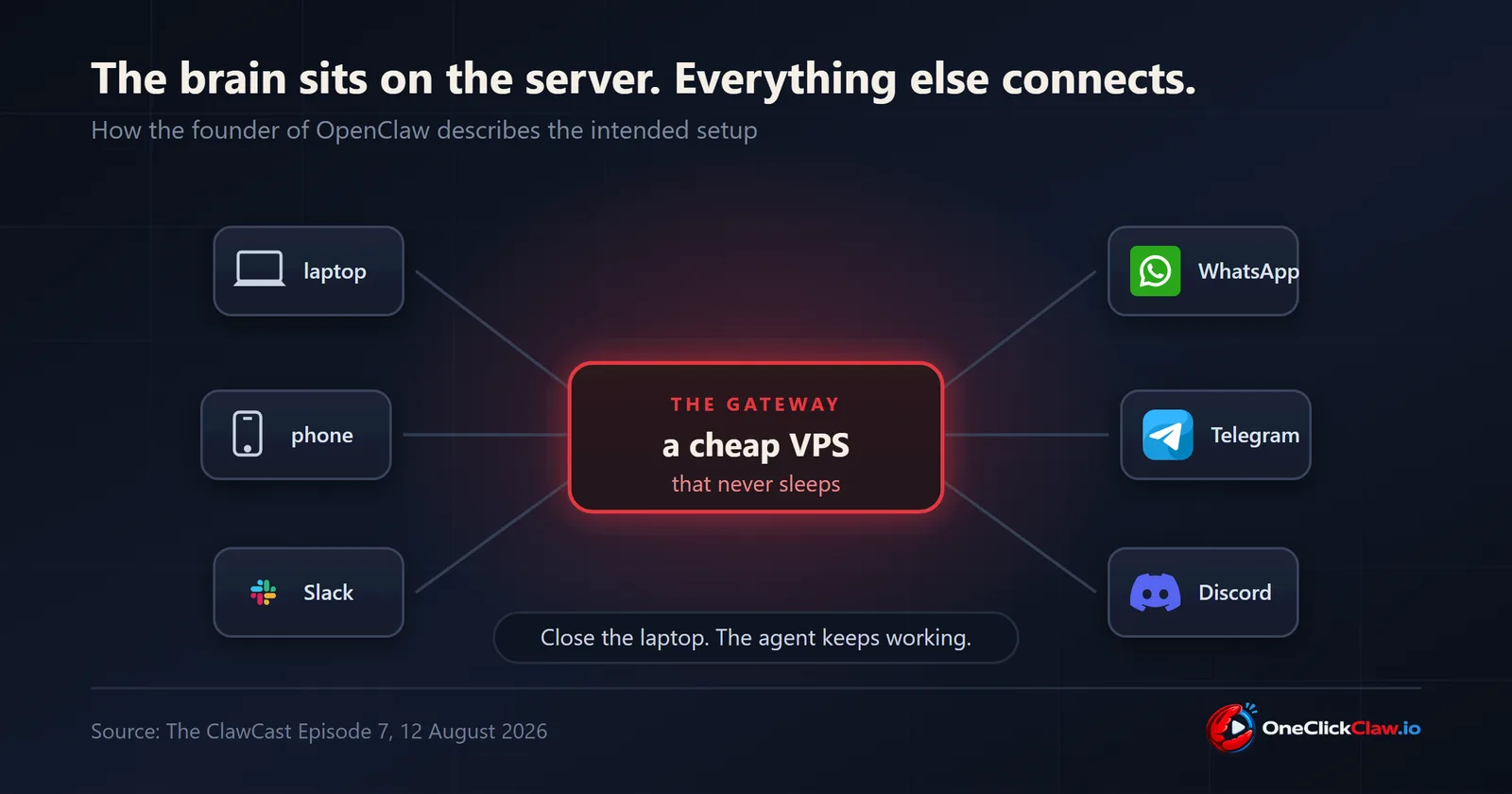
The line that describes how OpenClaw should run
Someone asked whether a stripped-down build was coming for very small machines. The answer was no, and the reason is the interesting part.
"The gateway is the thing that orchestrates everything, and you can just live on some cheaper VPS. And then you have nodes, which can be your computer, your phone, your watch."
Read that again, because it is the whole architecture in one sentence. The brain lives on a small always-on server. Everything else, including your laptop, is just a way to reach it. That is not a compromise, it is the intended design.
OneClickClaw.io runs that always-on gateway for you on a dedicated EU server from EUR 14.99 a month, so your agent keeps working when your laptop is shut.
Several people, one agent, everyone watching
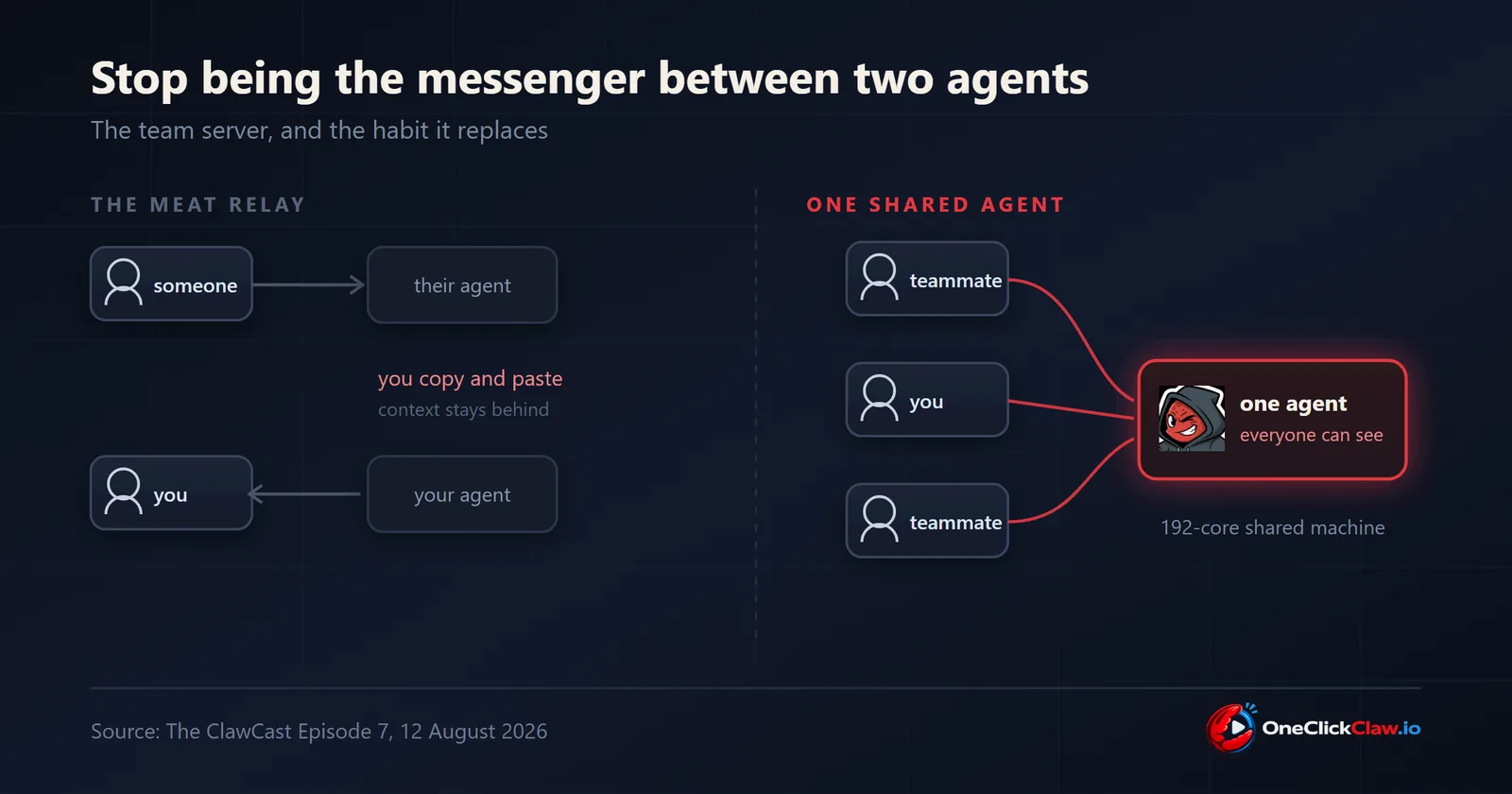
The maintainers now share a single OpenClaw instance on a 192-core machine. Somebody starts a job from Discord, it appears in the sidebar of the web interface, and everyone sees it, sees who started it, and can jump in and steer it.
The problem this kills has a name in the episode: being a meat relay. That is you, copying text between two agents, each holding context the other cannot see. As Patrick put it, a pull request is a terrible way to collaborate with somebody missing all your context.
Memory got quietly serious
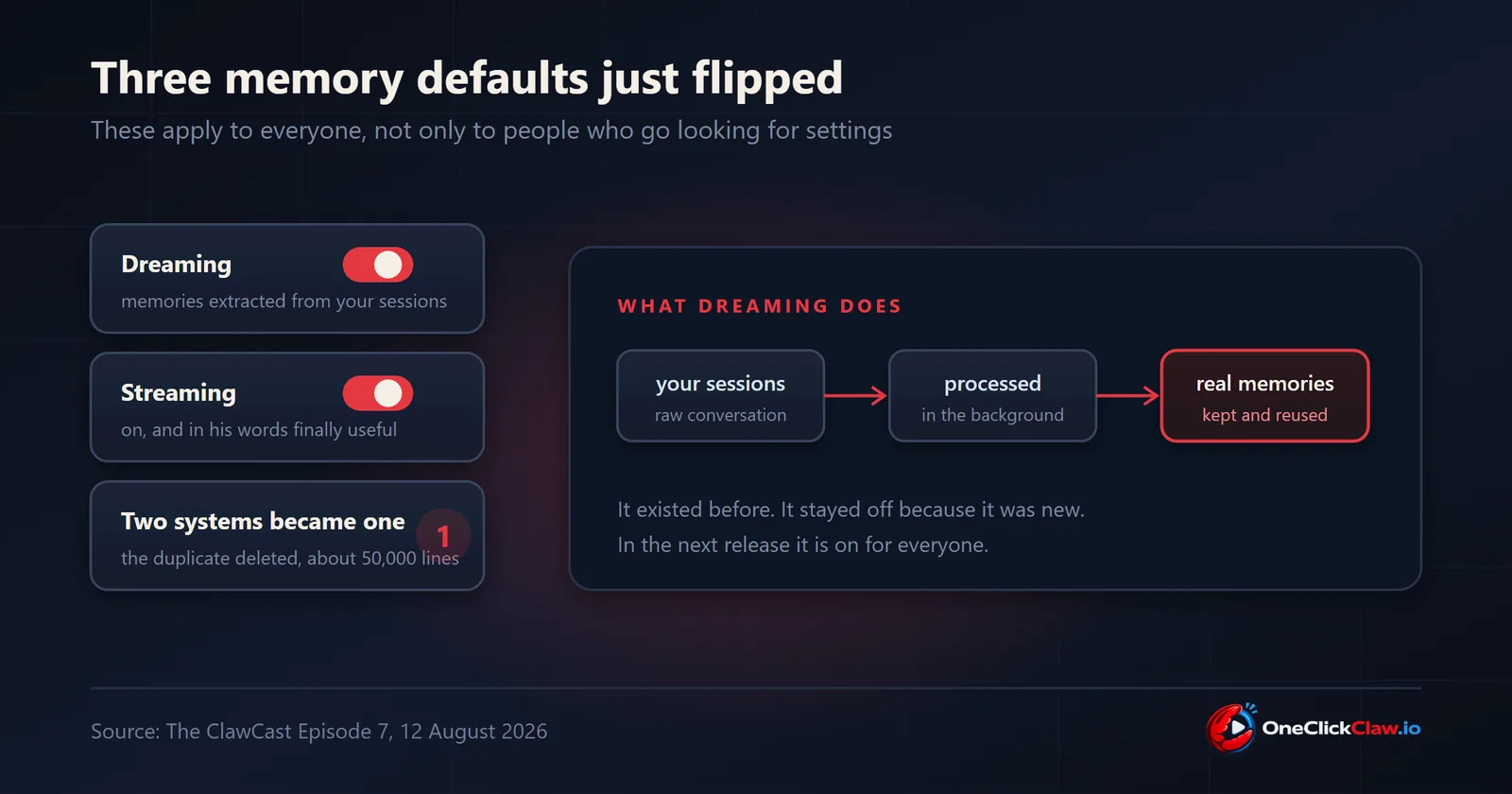
Three changes, all of them defaults, which means they affect everyone.
- Dreaming is now on. Your sessions get processed in the background and real memories are extracted from them. It existed before but stayed off because it was new.
- Streaming is on, and in his words it is finally useful.
- One memory system instead of two. The duplicate was deleted outright, about 50,000 lines of it, so the survivor gets all the attention.
Memory also stays pluggable, and nobody has solved it yet. The team says so openly, which is refreshing.
Four more things worth knowing
- Models update themselves. A public model list now lives on GitHub. When a new model needs no special plumbing, OpenClaw picks it up without waiting for a release. You can switch it off.
- The browser extension is back. It was retired when Chrome shipped its own approach, but that one threw an approval popup you could not press from your phone. Pair the extension once and your agent can drive the browser.
- Swarm. Your agent can now create agents. Spin up fifty to gather something, then synthesize the results. There is an incognito mode on the web too, where nothing is saved and nothing is learned.
- Setup configures itself. The new desktop app detects tools you already have, asks permission, and sets itself up in a few clicks. It also scans your installed applications, so connecting Slack or Notion becomes one click.
That last one comes with an admission. Asked why OpenClaw used to be hard to install, Steinberger did not deflect: "I didn't want to make it simpler. I wanted people to spend some time thinking about what it means if you install it on your computer." It was deliberate, during the months the project was being hammered about security. That stance is now reversed.
Run it cheaper, on purpose
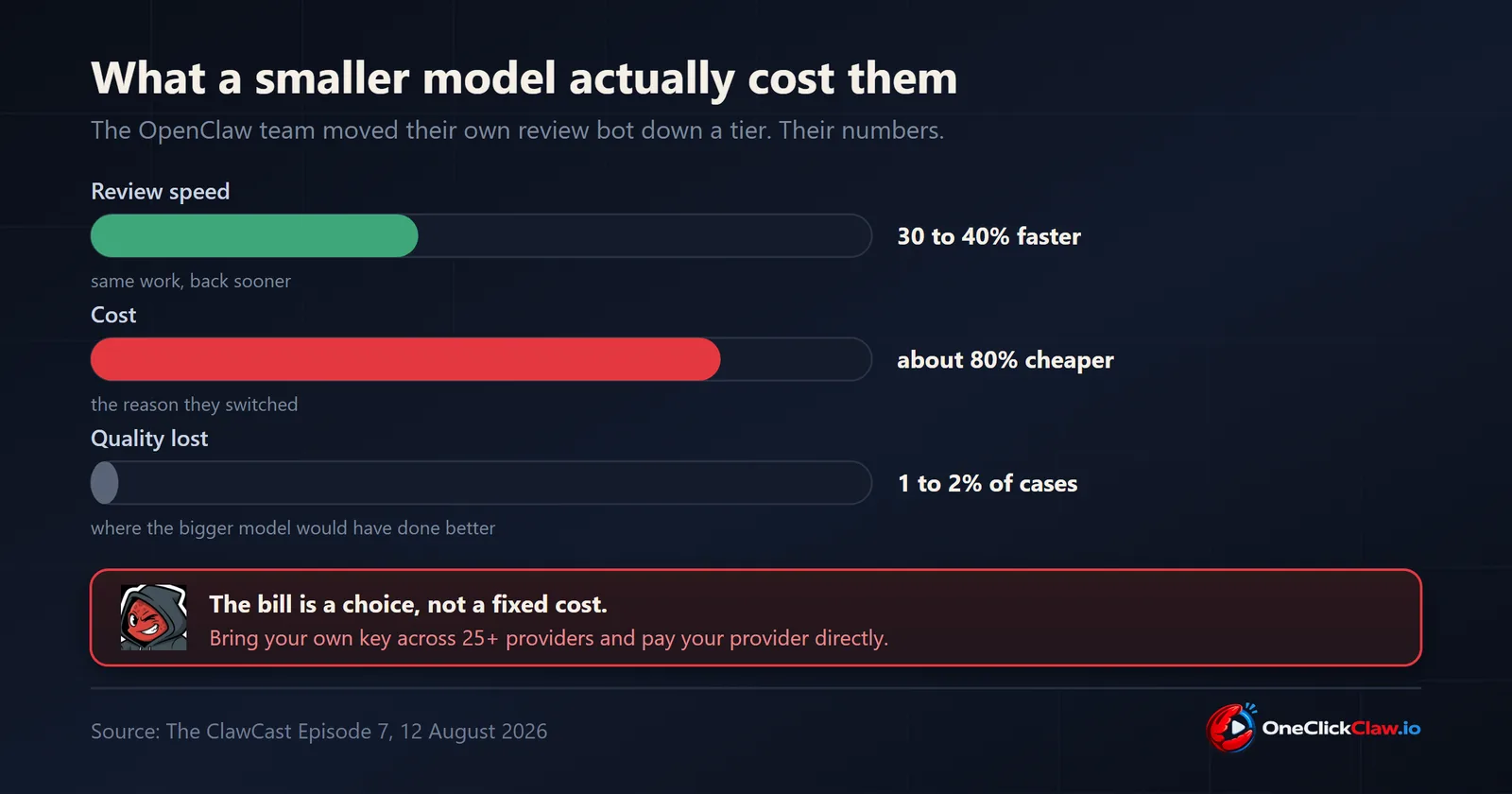
One number is worth writing down. The team moved their own code-review bot from a top-tier model to a lighter one. Reviews came back 30 to 40 percent faster at roughly 80 percent lower cost, and the quality difference showed up in only one or two percent of cases.
"If you're a little smarter on your use, and not just go yolo on everything, you can get a lot out of the subscription."
He also pointed at something only an open platform can do: plan with one model, do the work with a completely different one.
What it means for you: the bill is a choice, not a fixed cost. OneClickClaw.io is bring-your-own-key across 25 or more providers, so you pay your AI provider at their price with nothing added on top.
So when does it land
Recorded on 12 August, his answer was "a few days to a week away", and it is on the main branch already if you want to live dangerously. At the time of writing the released version is 2026.7.1-2 from 4 August, with 2026.8.1-beta.1 in testing and 2026.6.34 on the extended-stable channel for anyone who wants a slower pace.
The long wait has a cause: the whole storage layer moved from files to a proper database, and that had to happen before sessions could run for twenty or thirty hours without dragging.
He is honest about the risk too. During his own test migration a tool deleted some of his skills, with a fix out four hours later. His advice is worth repeating: keep your workspace in git, and let a coding agent handle the upgrade.
The part we would underline
Strip out the features and one idea runs through the whole hour. A small server that never sleeps, holding the brain, with everything else connecting to it.
That is what OneClickClaw.io is. A dedicated server in Denmark, provisioned in minutes, fully managed, running the OpenClaw gateway so you never touch SSH, Docker or a config file. When the new version arrives, we test it before it reaches you.
Try it free for seven days, on a real dedicated server, no card needed.
Source: Unfiltered Q&A with OpenClaw Founder Peter Steinberger, The ClawCast Episode 7, published 12 August 2026 on the official OpenClaw YouTube channel. Quotes are transcribed from the episode. Version numbers were checked against the npm registry and the GitHub releases page at the time of writing.
Source: www.youtube.com
Helpful documentation
Want your own AI agent running without the setup? We host it on a dedicated EU server. Free for 7 days, no credit card.
Start your free trialGet notified when we publish new articles
No spam, unsubscribe anytime.
By subscribing, you agree to our Privacy Policy.