
Subscribe to our newsletter
One short email when we publish. No spam, unsubscribe anytime.
OpenClaw Enterprise: what it means for one person or a small team
The OpenClaw Foundation announced OpenClaw Enterprise on 29 September 2026 in a post on the project's blog signed by Kevin Lin. The post describes it as an open source, vendor neutral platform for managing persistent agents in sensitive environments, built to run on an organisation's own servers and free for any organisation to use. Persistent agents are agents that stay running around the clock and keep their context between tasks. The Foundation wrote that the software is ready for internal pilot workloads today, meaning trial runs inside a company, and that the first full release is planned for later in 2026.
For a person running one OpenClaw agent, or a small team sharing one, nothing changes on the server they already have. The announcement describes Enterprise as building on the foundation set by OpenClaw and describes no change to the standard project. The standard project published a new release on the morning of 30 September 2026, one day after the announcement, according to its releases page on GitHub. Enterprise lives in a separate code base, created on 29 August 2026 according to GitHub.
Sources: OpenClaw Foundation blog, OpenClaw on GitHub, OpenClaw Enterprise on GitHub
What "Kubernetes for agents" means
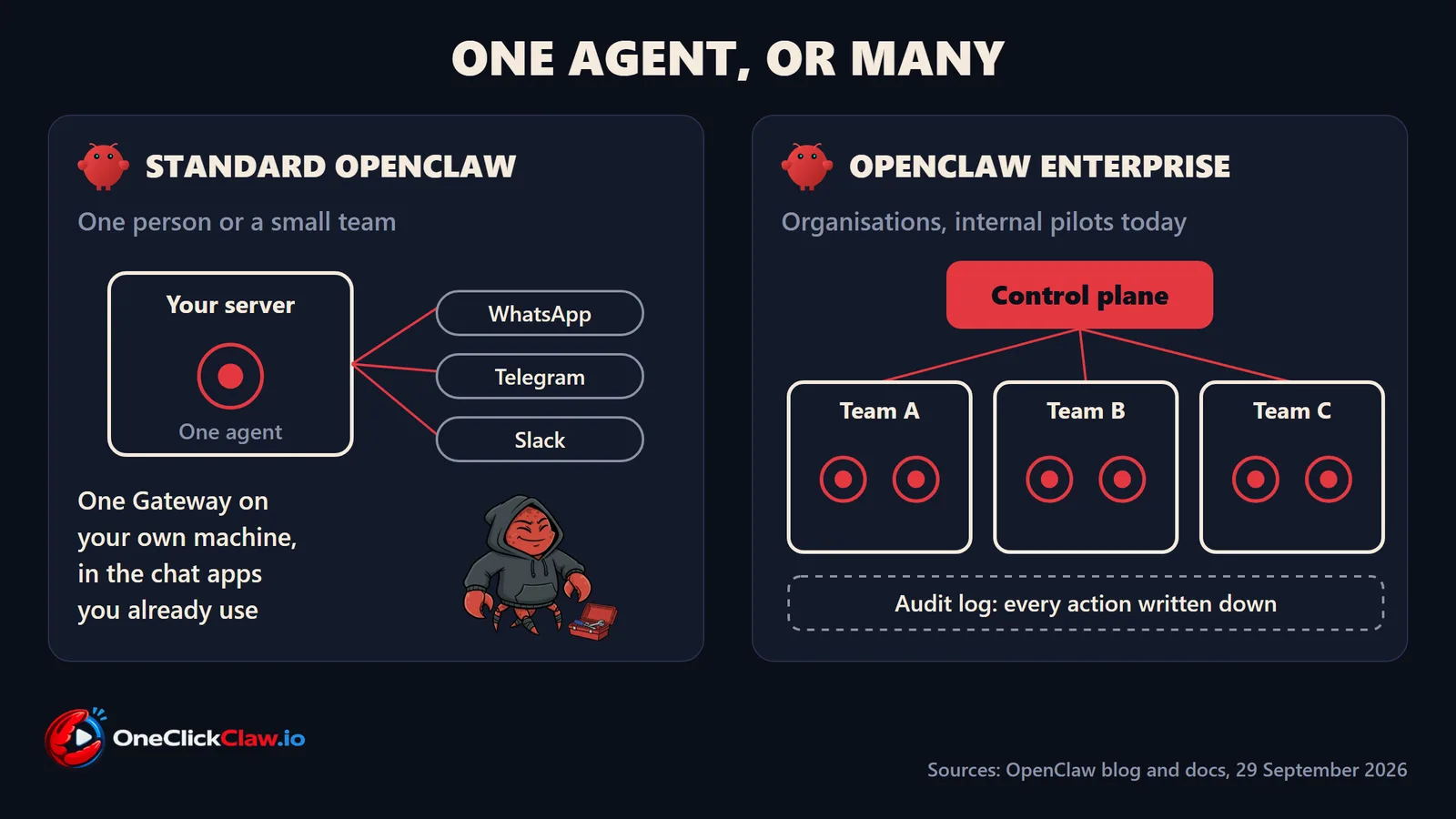
The project's own README, the front page of its code repository, opens with one line: think of it as Kubernetes for agents. Kubernetes is the software large companies use to run many small programs across many machines and keep them alive. Enterprise applies the same idea to agents through a control plane, one central place that starts, stops, updates and watches every agent an organisation runs.
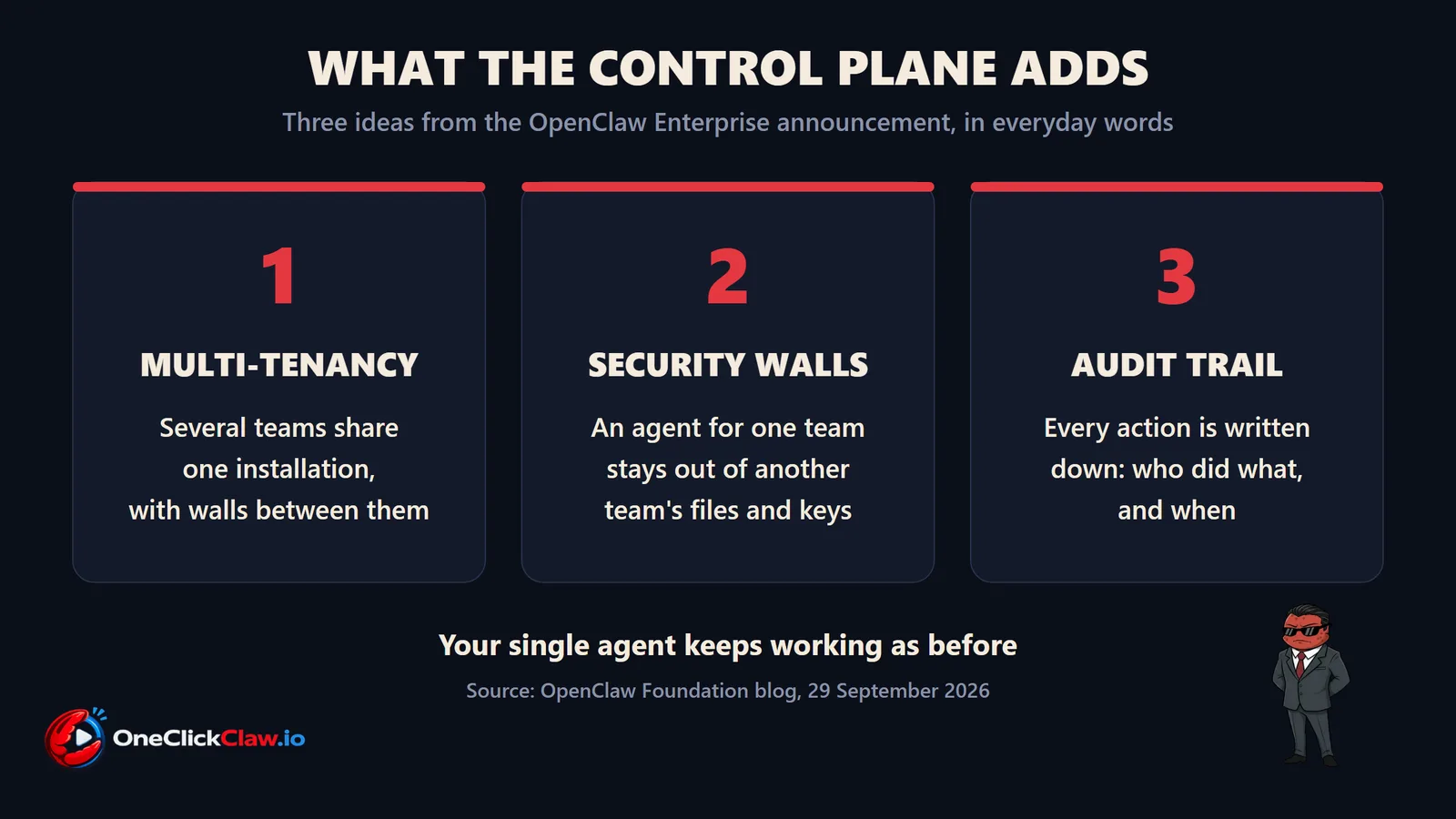
The announcement lists what that control plane adds on top of standard OpenClaw: multi-tenancy, hard security boundaries, standardised agent building blocks, and governance and auditability across the whole life of an agent. In everyday words:
- Multi-tenancy: several teams share one installation with walls between them.
- Hard security boundaries: an agent working for one team cannot reach another team's files or keys.
- Auditability: every action is written down, so someone can check later who did what and when.
The concepts page of the Enterprise documentation spells out the vocabulary. A Namespace groups and isolates its agents, configuration and credentials. A Principal represents a person, a Role defines permissions and a Restriction denies access. A Harness executes the agent's turns and tools. The announcement says the harness, the model and the sandbox, the walled-off space where the agent's actions run, can each be swapped for third party or internal implementations.
Sources: OpenClaw Enterprise on GitHub, OpenClaw Foundation blog, OpenClaw Enterprise documentation
Who built it and who runs it
The work started inside OpenAI, was donated to the OpenClaw Foundation and has since been developed together with Red Hat and NVIDIA, the announcement said. Red Hat and OpenAI both run it internally as pilots. RJ Marsan, a member of the technical staff at OpenAI, wrote in the same post that the company's internal agent, called Androidclaw, helps triage in chat channels, finds the code change behind a broken build and can publish a fix.
Red Hat published its own post the same day, signed by Joe Fernandes, vice president and general manager of its AI business unit. He described the software as an open control plane for deploying and operating persistent agents across users and teams, and wrote that Red Hat intends to deploy it internally. The Foundation's account on X posted the announcement the same evening; the post showed 2,015 likes and 88 replies the next day. The code carries the MIT licence, which lets anyone use, change and redistribute it.
Sources: OpenClaw Foundation blog, Red Hat blog, OpenClaw Foundation on X, OpenClaw Enterprise on GitHub
What it asks of the person installing it
The quickstart in the Enterprise documentation lists what a local installation needs: Docker Engine or Podman, k3d, kubectl and Helm, which together create a small Kubernetes cluster on one computer, plus Go, Node.js and pnpm to build the software. It asks for about 20 GB of free container storage for the first build. An OpenAI API key is needed to deploy the first agent. The documentation describes that path as being for development; the other path deploys onto an existing Kubernetes cluster.
The public repository counted 150 stars, 14 forks and 95 open issues on 30 September 2026, with no tagged release yet. The main OpenClaw repository counted 390,813 stars on the same day.
Sources: OpenClaw Enterprise documentation, OpenClaw Enterprise documentation, OpenClaw Enterprise on GitHub, OpenClaw on GitHub
What stays the same for one person or a small team
The standard OpenClaw documentation describes the product in one line: your AI assistant, on your own hardware, in every chat app you already use. It says you run a single Gateway process on your own machine or a server, and that the same gateway runs as a personal assistant on one laptop or as a shared team deployment. The chat apps it lists include WhatsApp, Telegram, Signal, Slack, Discord, Microsoft Teams and Google Chat.
That is the setup a freelancer, a two-person shop or a small agency runs today: one agent, one server, a few chat apps, one model key. Enterprise addresses a different situation. The Foundation wrote that the most common feedback from organisations is a call for a shared standard on security, safety and governance, and that the default stance of IT in most organisations has been to ban agent platforms altogether. The Foundation said a reference architecture showing how the protections work together will follow in the coming weeks.
For a small team the practical reading is short. The agent on your server keeps working as before. The security ideas being tested in the pilots at OpenAI and Red Hat are being built in the open, and the Foundation invited developers, operators and security teams to help shape them before the first full release.
Sources: OpenClaw documentation, OpenClaw Foundation blog
One agent, always on
Enterprise or standard, an agent only answers when its server is awake. OneClickClaw runs standard OpenClaw for you on a dedicated server in the European Union, with SSL, firewall, updates, backups and monitoring handled. The Starter plan costs EUR 14.99 a month and the 7-day free trial needs no credit card. Start the trial at oneclickclaw.io.
Sources: OneClickClaw plans
Source: openclaw.ai
Helpful documentation
Want your own AI agent running without the setup? We host it on a dedicated EU server. Free for 7 days, no credit card.
Start your free trialGet notified when we publish new articles
No spam, unsubscribe anytime.
By subscribing, you agree to our Privacy Policy.