
Subscribe to our newsletter
One short email when we publish. No spam, unsubscribe anytime.

Same price, a quarter of the bill: what an always-on OpenClaw agent costs after Claude Fable 5.1
Anthropic released Claude Fable 5.1 on 1 September 2026 at the same headline price as Claude Fable 5, $10 per million input tokens and $50 per million output tokens, and cut the price of reading a cached prompt from $1 to $0.25 per million tokens, according to the company's pricing page. For an OpenClaw or Hermes Agent that runs all day and re-reads the same instructions on every message, that one line is most of the bill.
The pricing page states that cache hits on Claude Fable 5.1 and Claude Mythos 5.1 "are priced at 0.025x the base input price" and that "all other models use the standard 0.1x multiplier". VentureBeat reported the change on 1 September 2026 as a 75 percent cut on cache reads and wrote that Fable 5.1 "retains Fable 5's headline API rates".
Why the cache line is the bill
OpenClaw's documentation says the gateway "assembles its own system prompt on every run", including the tool list, the skills list and the workspace files, and that "everything the model receives counts toward the context limit", conversation history included, according to the token use reference. The same documentation describes prompt caching as a way for the provider to "reuse an unchanged prompt prefix (system/developer instructions, tool definitions, other stable context) across turns", and notes that on Anthropic "cache reads are significantly cheaper than input tokens", per the prompt caching reference.
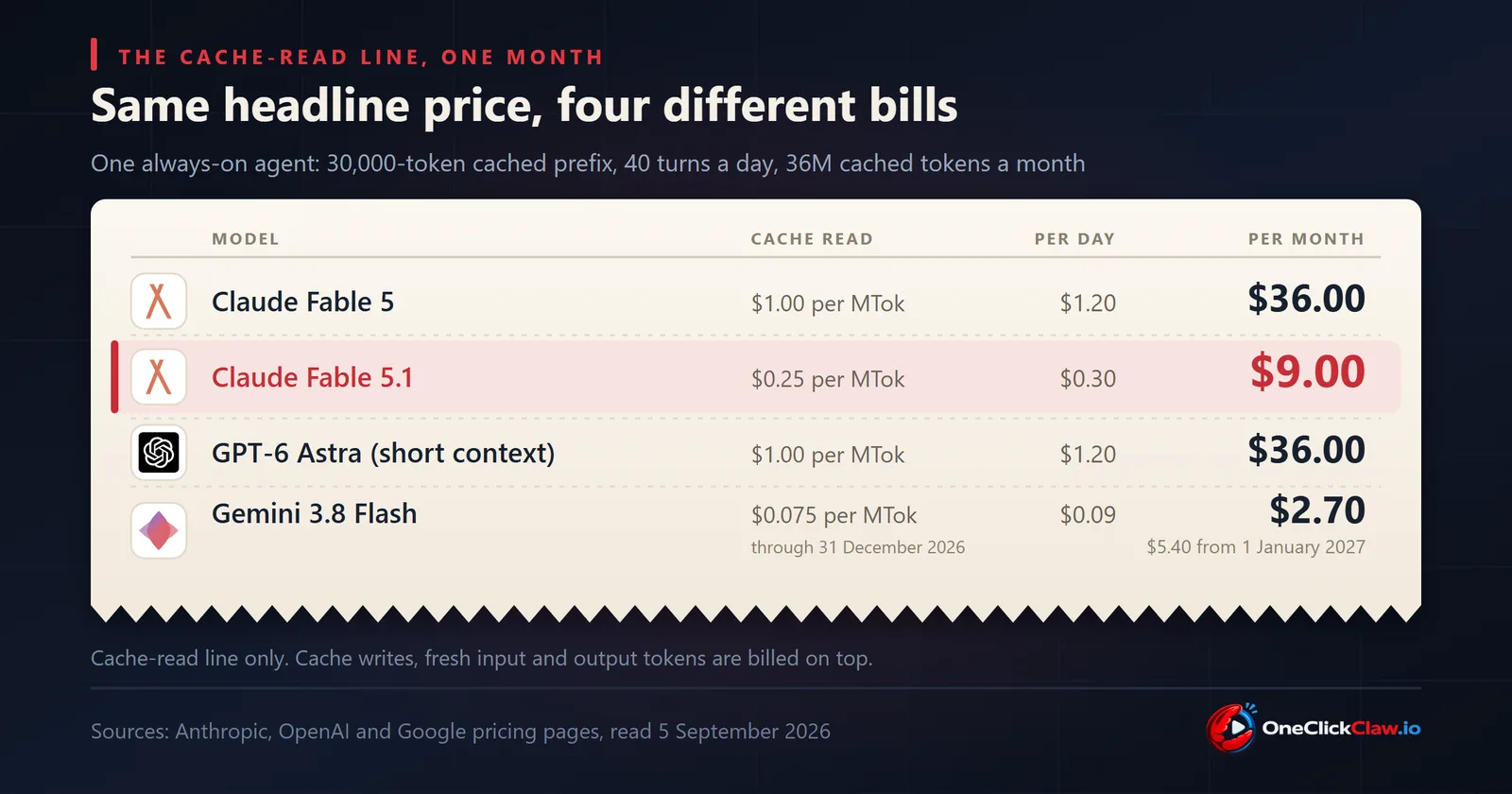
In plain terms, every message a chat-connected agent receives sends the whole pile back to the model, and the pile is mostly the same as last time. The provider charges the repeated part at the cache-read rate. A 30,000-token prefix read 40 times a day is 1.2 million cached tokens a day and 36 million a month.
One workload, four price sheets
The table applies that workload, a 30,000-token cached prefix and 40 turns a day, to the cache-read line of each vendor's published rate, as read on 5 September 2026. Cache writes, fresh input and output tokens are billed on top and are left out, because they change nothing between the four rows that matters here.
| Model | Cache read, per million tokens | Per day | Per month |
|---|---|---|---|
| Claude Fable 5 | $1.00 | $1.20 | $36.00 |
| Claude Fable 5.1 | $0.25 | $0.30 | $9.00 |
| GPT-6 Astra, short context | $1.00 | $1.20 | $36.00 |
| Gemini 3.8 Flash | $0.075 through 31 December 2026, $0.15 from 1 January 2027 | $0.09, then $0.18 | $2.70, then $5.40 |
The Claude rows come from the Anthropic pricing page. The OpenAI changelog dates the GPT-6 Astra release to 3 September 2026, and the OpenAI pricing page lists it at $10 input, $1 cached input and $50 output per million tokens for short context, with a long-context tier at $20, $2 and $75. The Google changelog dates gemini-3.8-flash general availability to 2 September 2026, and the Google pricing page lists input at "$0.75 through December 31, 2026. $1.50 starting January 1, 2027" and context caching at "$0.075 through December 31, 2026. $0.15 starting January 1, 2027".
Three lines that do not fit in a table. GPT-6 Astra and Claude Fable 5.1 share the same $10 and $50 headline and sit four times apart on the cache line. Google's pricing page also lists a storage charge for context caches of $0.50 per million tokens per hour through 31 December 2026, and Google's caching documentation says implicit caching is enabled by default, with savings passed on "if your request hits caches". On the same Anthropic page, Claude Sonnet 5 reads cache at $0.20 per million tokens, which puts the same workload at $7.20 a month.
Who gets the full cut
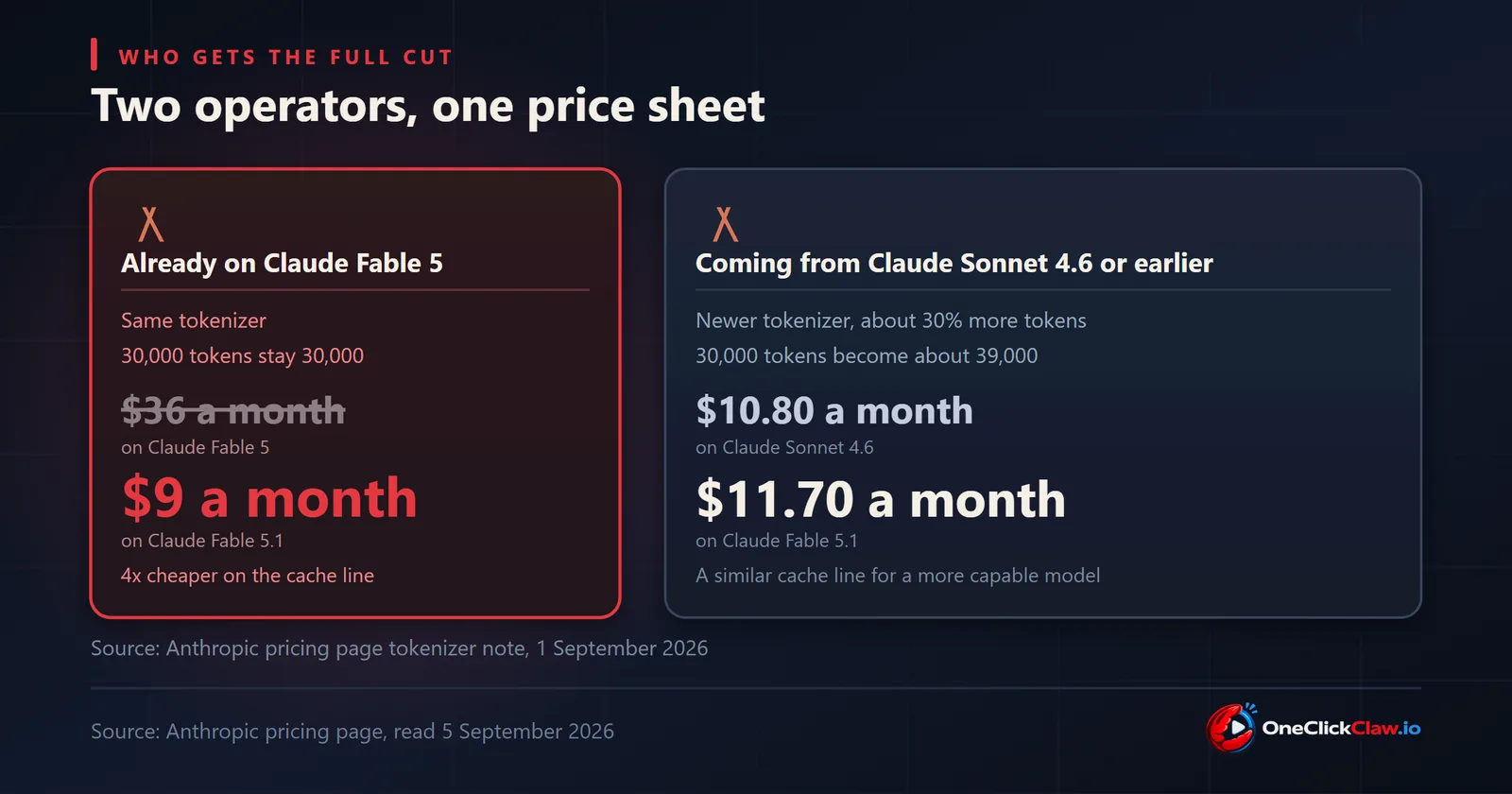
The Anthropic pricing page carries a note that "Claude 4.7 and later models" use a newer tokenizer that "produces approximately 30% more tokens for the same text", and that "Claude Sonnet 4.6 and earlier models use the previous tokenizer". Claude Fable 5 and Claude Fable 5.1 sit on the same side of that line.
An operator already on Claude Fable 5 keeps the same token count and sees the cache line fall from $36 to $9 a month, a fourfold cut with nothing else changing. An operator moving from Claude Sonnet 4.6 sees the 30,000-token prefix become about 39,000 tokens on Fable 5.1. Sonnet 4.6 reads cache at $0.30 per million tokens on the same page, so that operator's cache line is $10.80 a month today and about $11.70 a month on Fable 5.1, a similar figure for a model two tiers up. The headline input rate on that path moves from $3 to $10 per million tokens.
Two lines to read before changing the model ID
Anthropic's API release notes for 1 September 2026 state that on Claude Fable 5.1 and Claude Mythos 5.1 the tool_choice types "any" and "tool" "aren't supported and return a 400 error", while "auto" and "none" are unchanged. The OpenAI changelog entry for 3 September 2026 states that on GPT-6 Astra "tool calling requires the Responses API". An agent configuration that forces a tool call, or that talks to OpenAI through Chat Completions, needs a change before the new model ID goes in.
What this means for a server that never sleeps
The cache-read rate applies while there is a cache to read. The Anthropic pricing page lists the two cache durations at five minutes and one hour, and OpenClaw's prompt caching reference sets the Anthropic default to the five-minute window with a one-hour option through the cacheRetention setting. An agent that answers throughout the day keeps that prefix warm on the provider's side. An agent that goes offline with the laptop pays the write price again when it comes back.
OneClickClaw runs OpenClaw 2026.8.2 and Hermes Agent v2026.8.31 on a dedicated server per customer, from 14.99 euro a month on the Starter plan, according to the plans page read on 5 September 2026. The seven-day free trial runs on a real Starter server and asks for an email address, with no card. That is long enough to run one agent for a week and read the cache line on the provider's console.
Start the seven-day free trial and give your agent a machine that keeps the cache warm.
Source: platform.claude.com
Helpful documentation
Want your own AI agent running without the setup? We host it on a dedicated EU server. Free for 7 days, no credit card.
Start your free trialGet notified when we publish new articles
No spam, unsubscribe anytime.
By subscribing, you agree to our Privacy Policy.